The piece of hardware that turns an electric truck into a home battery. Today the vehicle picks the home equipment: GM’s kit for GM, Tesla’s for Tesla, Ford’s for Ford. A safety standard released in May and a testing program that opened in September point to wall chargers that work across brands, starting with trucks like the Ford Fathom that carry their own inverter.
Updated November 15, 2026.
A normal EV charger moves power one direction: from your house into the vehicle. A bidirectional charger moves it both ways. In an outage, it pulls power out of the vehicle's battery and feeds your home.
Before your vehicle can run the house, the house has to be cut off from the power lines. A transfer switch does that. It keeps your truck from back-feeding the grid, which protects line crews, and it's what makes a vehicle-to-home setup safe and code-compliant. A licensed electrician installs it.
An EV battery stores DC power; a house runs on AC. Something has to convert it, an inverter, and it can sit in one of two places.
In the wall box (DC). This is how most home backup works today. The car sends DC power out the charging port and the wall unit converts it. The car and the wall unit have to be approved to work together, which is why each maker sells its own setup and why third-party boxes list only certain vehicles.
In the vehicle (AC). The car converts its own power and sends AC out the port. The wall box only has to supervise the connection, which makes it simpler and should make it cheaper. Ford says the Fathom works this way, sending a projected 10 kW to a house without a separate wall-mounted inverter.
On May 21, 2026, UL released UL 1741 Supplement SC, a safety standard for home chargers on the AC side. A charger certified to it can supervise any vehicle built and tested to SAE J3072, the standard for a car’s own two-way inverter, without the car and charger being certified as a matched pair. In mid-September UL Solutions opened testing to the new standard at its labs in Fremont, California and Northbrook, Illinois.
That is the groundwork for a wall charger that works with whatever qualifying EV you park under it. As of the September announcements, no charger had been named as certified, and automakers still have to certify their vehicles to SAE J3072. Ford has not said whether the Fathom’s Home Power Station will work with other brands.
| Charger | Vehicles | Power | Price | Status |
|---|---|---|---|---|
| Wallbox Quasar 2 | Kia EV9; Kia EV6 (2025 and later) in PG&E’s program | 12 kW | $6,489, plus an estimated $4,500 installed and up to $1,000 grid hookup fee (Wallbox) | On sale |
| dcbel Ara Core | PG&E pairs it with the Nissan Leaf (2018–2025), 2025 Volvo EX90 and Polestar 3 | Not published | $9,999 ($200 deposit) | Sold through dcbel installers |
| Enphase IQ Bidirectional EV Charger | Any EV that meets ISO 15118-20 once its maker turns on two-way power; none named yet | 11.5 kW | Not published | Expected in 2026; CCS1 or NACS cable; works without a home battery using Enphase’s meter collar |
Prices from Wallbox’s and dcbel’s own stores; vehicle pairings from Wallbox, Enphase and PG&E’s August 2026 program update. For comparison, Tesla puts its Powershare equipment at typically $1,950, plus about $2,000–$4,000 to install without a Powerwall; GM does not list a base price for its V2H Bundle.
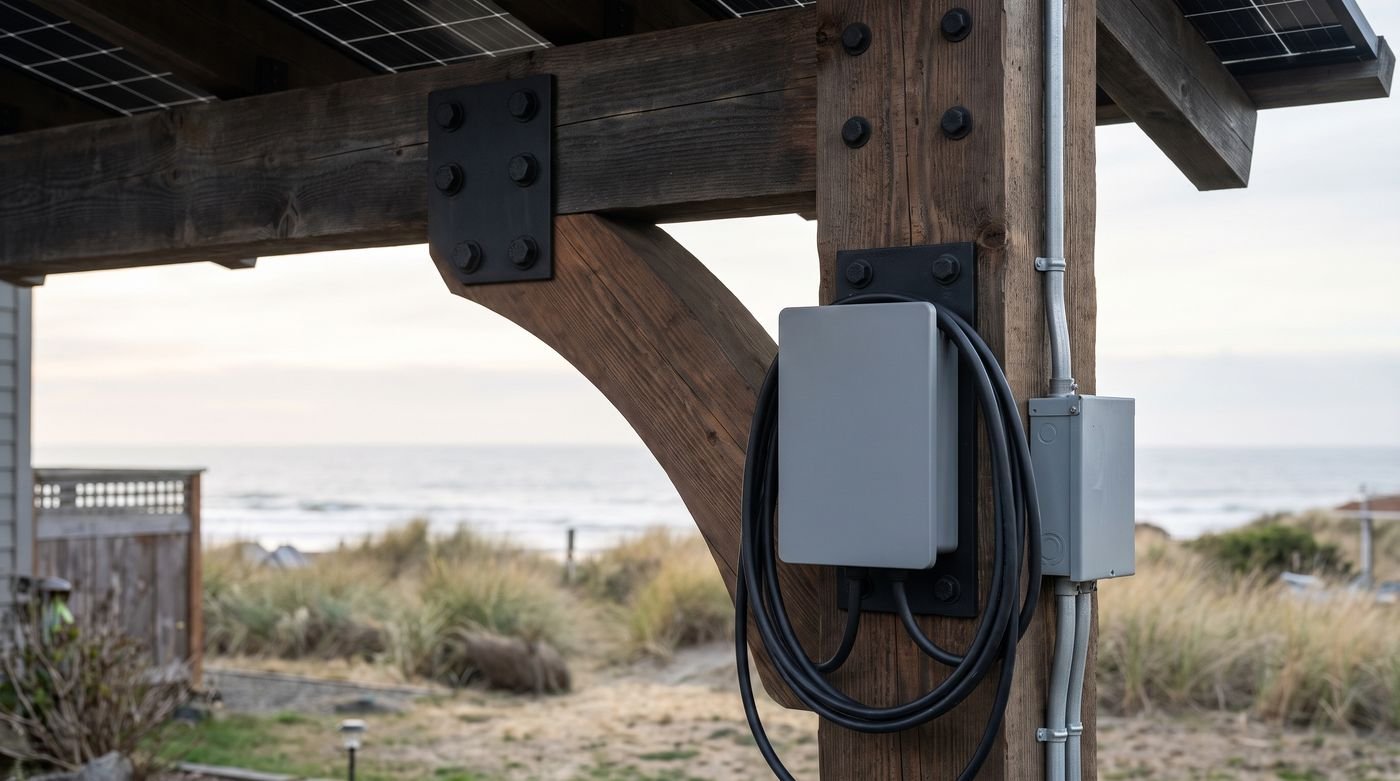
Put in the parts that don’t care what you drive: a heavy circuit and conduit to the carport, room in the electrical panel, and space for a backup panel or transfer switch. Add the two-way charger when you know the vehicle. Your electrician sizes the circuit, and your utility has to approve any equipment that sends power back. The solar roof and the timbers work with whatever is parked underneath.
In California, PG&E is paying $2,500 up front ($3,000 in disadvantaged communities) toward approved vehicle-and-charger pairs through June 30, 2027, with up to $13,000 more for some combinations.
Every truck and SUV that can power a house →
Ford Fathom price and home power →
Not one you can buy today that backs up a house from any EV. Third-party chargers like the Wallbox Quasar 2 and dcbel Ara work with short, specific lists of vehicles. Enphase says its IQ Bidirectional EV Charger will work with any EV that meets ISO 15118-20 once the automaker enables two-way power, but it had not launched as of November 2026.
A safety standard released May 21, 2026 for home chargers that send power both ways when the inverter is in the vehicle. A charger certified to it can supervise any vehicle certified to SAE J3072, without the car and charger being approved as a matched pair. UL Solutions began testing chargers to it in September 2026.
No. Today each maker’s home backup equipment is approved for its own vehicles: GM Energy’s V2H Bundle for GM EVs, Tesla’s Powershare equipment for Teslas, and Ford’s home equipment for Ford trucks.
The parts that don’t depend on the vehicle: a heavy circuit and conduit to the carport, room in the electrical panel, and space for a backup panel or transfer switch. Buy the two-way charger once you know the vehicle. Your electrician sizes the circuit, and your utility has to approve any equipment that can send power back.
Time-of-use electricity rates by utility: overnight and peak prices for SDG&E, PG&E, SCE, Georgia Power, Keys Energy, Brunswick EMC, Dominion SC, Sant
Read it →
Where building codes let a home battery go (inside, attached garage, outside wall, detached structure), the size limits, bumper protection, heat alarm
Read it →
What it takes for a solar carport or pergola to survive the coast: design wind speeds, uplift, salt-air corrosion, the right steel and fasteners, trea
Read it →
Have a question we did not answer? Write to stan@generatorenvy.com. Stan grumbles, but a real person answers.
 Generator